Looking for Bankers/Entrepreneurs/Ex-Policy Makers/Consultants to Volunteer

IMG_0160-e1304225626547.jpg

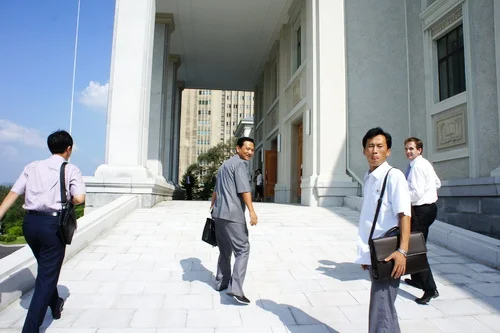
We are looking for volunteers with an interest in North Korea and the right skill sets to lead workshops in Pyongyang in the September-October period, and for North Koreans outside of Pyongyang in the July-August period.

Those with the following skill sets would be most appreciated and are welcome to email us at CEteam@chosonexchange.org to discuss volunteering opportunities. Those with relevant experiences outside of these areas are welcome to join our mailing list and Facebook page to stay in touch about future opportunities:

Economic Policy 1. Fiscal & Monetary Policy 2. Business Environment Development 3. Investment Policy & Sourcing

Banking 1. Risk Management - Credit, FX, Market, Liquidity, Operational...etc. 2. Asset-Liability Matching 3. Banking IT Systems

Entrepreneurship 1. Developing Business Plans 2. Feasibility Studies

April 2011 Financial Sector Post-Trip Report

IMG_0133-e1304139772142.jpg

We completed a round of consultations with the financial sector and investment policy sector in North Korea in April. We have attached non-sensitive and non-confidential details from the trip below. We do not vouch for the veracity of comments of participants, and details are given as described to us by relevant members of the respective organizations.

For our post-trip report on the financial sector and investment committees, please see "April 2011 Financial Sector Consultations."

Sections:

1. [REMOVED] 2. [REMOVED] 3. Daesong Bank 4. Kim Il Sung University Financial College 5. Foreign Trade Bank 6. Joint Venture & Investment Commission 7. Daepung Group & National Development Bank

New Addition to Risk Management/Economist Team

DSC00506-e1303652729354.jpeg

We would like to welcome our latest addition to the team as we expand our Risk Management/Economist workshop leader team in preparation for programs in July, August, September and October in Pyongyang and elsewhere. We appreciate Gregory Levin for his valuable time and expertise that he will contribute to our mission.

Greg's Bio:

Greg is an Asia country risk analyst and economist for a major U.S.-based financial institution. In recent years, he worked in various roles related to foreign exchange trading and market analysis for the Federal Reserve Bank of New York as well as a major economic advisory firm in New York City. He previously helped co-start a firm to attract investment into Chinese infrastructure projects in Shanghai. Greg has a masters in international economic policy from Johns Hopkins University School of Advanced International Studies (SAIS). He also attended Nanjing University for a one-year certificate program in Mandarin Chinese, and received his B.A. in Chinese Studies from Connecticut College.

April Financial Sector Consultations in Pyongyang

DSC00555-e1302538317472.jpeg

We will be bringing a team to Pyongyang for consultations and discussions on financial sector development from April 16 onwards for 2 to 3 weeks. For these consultations, we arranged to meet with the following institutions:

Kim Il Sung University Finance College Korea National Development Bank Daesong Bank Foreign Trade Bank Daepung Group Joint Venture & Investment Commission

International Section, Worker's Party

New Lecturer in Exchange Rate Policy & Financial Sector Policy in Singapore

As we prepare programs to launch in Singapore, we are glad to welcome Professor Charles Adams who will assist us in his personal capacity as a former IMF official who possesses expertise in exchange rate policy and financial sector polices - key areas we are emphasizing in our programs. His bio is as follows: Charles Adams’ research areas include exchange rates; financial market developments and issues; monetary policy formulation; and regional economic integration and co-operation. He has published widely in various journals and recently co-edited a book on financial and corporate restructuring in the aftermath of the Asian crisis. For close to 25 years, Charles Adams was an official at the International Monetary Fund (IMF) where he worked on the IMF’s World Economic Outlook and International Capital Markets Reports and was, until last year, Assistant Director at the IMF’s Regional Office for Asia and the Pacific located in Tokyo.

During the last few years, he represented the IMF at regional policy meetings of APEC, ASEAN, ASEAN +3, EMEAP and SEACEN and also represented the IMF on the Financial Stability Forum Working Group on Highly Leveraged Institutions. Since leaving the IMF, Charles Adams has been a visiting professor at Singapore Management University and a consultant in the Office of Regional Economic Integration at the Asian Development Bank.

Banking & Finance Resource for North Korean Students & Professionals

Photo courtesy of the Korea Economic Institute. Compiled by Greg Levine Economist at a major global commercial and investment bank

Photo courtesy of the Korea Economic Institute. Compiled by Greg Levine Economist at a major global commercial and investment bank

The following is a resource guide on learning about the banking sector which we compiled for North Korean students studying overseas as well as for our in-country programs.

Issue of bank assets and asset management

The Bank for International Settlements has an excellent website for free research on developments in bank asset management. (http://www.bis.org/)

Some good papers of possible interest:

"Sound credit risk assessment and valuation for loans" (http://www.bis.org/publ/bcbs126.pdf)

"Supervisory guidance for assessing banks’ financial instrument fair value practices" (http://www.bis.org/publ/bcbs145.pdf)

The Euromoney website offers some good information on many of these topics as well. (http://www.euromoney.com/)

A summary "How to" guide on bank liquidity management.

(http://www.euromoney.com/images//502/77344/Liquiditymanagement_sept10_WEBFINAL.pdf)

The NY Federal Reserve has a very good website with dozens of topics related to banking, supervision, and asset management. (http://www.newyorkfed.org/index.html)

Their report on foreign exchange risk management might be good for banks with extensive foreign exchange exposure.

- "Management of Operational Risk in Foreign Exchange" (http://www.newyorkfed.org/fxc/2004/fxc041105b.pdf)

Issue and trade of stocks, asset investment, securitization, fundraising and management

Investopedia is a good investor site. They have good basic articles on trading stocks, characteristics of the market, and other assets. (http://www.investopedia.com/)

Their "investing basics" article has a good overview that links to many other articles: http://www.investopedia.com/articles/basics/

Types of bank loans, collaterals and guarantees

Very basic background on bank loan types. (http://www.ehow.com/about_4672890_types-bank-loans.html)

A short introduction on defining bank debt. (http://www.ehow.com/about_7237606_define-bank-debt.html)

[this topic can get complex, but the Federal Reserve site has some articles on this as well; let me know if you have any questions]

Law and regulations concerning bank management

The Federal Reserve publishes regulations on bank services based on U.S. law. This site is huge but can be useful if you have a detailed question in mind. (http://www.federalreserve.gov/bankinforeg/reglisting.htm)

Accounting principles concerning bank and its financial statement

Basic accounting information and overview can be found at a free online accounting textbook. (http://www.principlesofaccounting.com/chapter1/chapter1.html)

Issuing of banking cards and its settlement system

A good background on credit cards and settlement systems: (www.cardpaymentsolutions.com/docs/Bankcard_101.doc )

For more details on settlement systems and developments, you can reference the BIS website:

"Principles for financial market infrastructures - consultative report" (http://www.bis.org/publ/cpss94.htm)

Bonds trading on international financial market

Wikipedia has a good overview of the bond market here: (http://en.wikipedia.org/wiki/Bond_market)

For details, try Securities Industry and Financial Markets Association (SIFMA). The SIFMA site is excellent and provides data as well as reports and educational material. http://www.sifma.org/research/

Their page on bond markets might be very useful for you:

http://www.sifma.org/Education/Industry-Basics/Capital/Securities/

A few more sites you might be interested in ...

McKinsey & Co. offers an interesting background on Asia banking opportunities. Membership to the site is free, and they provide regular emailed reports on industries if you sign up for them.

https://www.mckinseyquarterly.com/PDFDownload.aspx?ar=2763&srid=17

Their recent article on "Asia's $1 trillion infrastructure opportunity" gives some basic infrastructure / financing principles along with some of the opportunities being looked at these days in Asia.

https://www.mckinseyquarterly.com/PDFDownload.aspx?ar=2765&srid=17

Expanding Our Singapore/SEA Based Team

DSC01798.jpeg

We are keeping an eye on conducting future knowledge-exchange workshops in Singapore for selected North Korean institutions. With this in mind, we are expanding our current Singapore and Southeast Asia-based team of volunteers and advisors with a particular focus on expertise in fiscal and monetary policy, development strategy, banking, and country debt negotiations. We would like to welcome the following people to our regionally-based team and thank them for their valuable time and advice: Manu Bhaskaran Manu is principal and CEO in Centennial Asia Advisors, a strategic advisor on policy and corporate issues. Manu spent 20 years analyzing political and economic trends in Asia, first for the Singapore Ministry of Defense in the area of regional security and then for 12 years as Chief Economist and Chief Strategist for Asia of SG Investment Bank, the international investment banking arm of Societe Generale. He is a frequent speaker on Asian issues at major conferences such as the World Economic Forum. Although Mr Bhaskaran left service with the Singapore government in 1989, he has continued to participate in several governmental initiatives. He is also on the board of a listed Singapore government-owned company and is a Council Member of the Singapore Institute of International Affairs which advises the Singapore Foreign Ministry. He has also served as a Visiting Fellow at the Institute of Policy Studies, a Singapore think tank. Mr Bhaskaran has a MPA from the Kennedy School of Government at Harvard University and a B.A. in economics from Cambridge University.

Donald Low Donald Low established the Centre for Public Economics at the Civil Service College in Singapore in 2009 and served as its first director for two years. Prior to joining the college, he served in various capacities in the Singapore government. He was the Director of Fiscal Policy at the Ministry of Finance in 2004-2005 where he oversaw fiscal management, tax and budget issues, and the Director of the Strategic Policy Office in the Public Service Division in 2006-2007 where he led a number of inter-department project teams on cross-cutting issues affecting Singapore. He holds a double first in Politics, Philosophy and Economics from Oxford University, and a Masters in International Public Policy from Johns Hopkins University’s School of Advanced International Studies. He is also the editor of the upcoming book Behavioural Economics and Policy Design: Examples from Singapore, and serves as a Vice President in the Economics Society of Singapore.

Namuh Rhee Namuh Rhee is a Managing Director at Bank of America Merrill Lynch in Singapore. Prior to joining BOA-ML, he was a founding partner of Rhee Capital, an Asia-focused hedge fund, non-executive director and Member of the Board of Directors at Citibank Korea, Managing Director at Samsung Securities and Vice-President at JP Morgan. Namuh has an MBA from the University of Chicago Graduate School of Business and a B.A. in Economics from Seoul National University.

Tan Wee Cheng | Finance & Accounting | Currently an Adjunct Associate Professor at National University of Singapore, Wee Cheng was in past lives an investment banker, Central Bank regulator and ex-CFO of a Chinese Chemical Company. Wee Cheng brings with him a wealth of experience in making financial, policy and business decisions across a wide-range of business environments and contributes this knowledge to our programs. He has an MBA from the London Business School and a B.A. from the National University of Singapore.

Marco Breu | Finance & Banking | Marco Breu is the Managing Partner of a global management consultancy’s practice in Thailand and head of the practice’s Vietnam office. In his 10 years as a consultant, Marco has served over 30 different companies in 8 industries in over 20 countries in Asia, Europe, the Middle East, and North America. His main areas of expertise are banking, public sector, and infrastructure. Prior to joining the firm, Marco worked in the asset management industry. He is also a part-time lecturer at the National University of Management in Phnom Penh, Cambodia and the National University of Economics in Vientiane, Laos as well as one of the organizers of an entrepreneurship program for the Mekong region. He has a Masters Degree of Economics from the University of Berne, Switzerland.

North Korea: Australia’s capacity to act where others cannot

Choson Exchange recently prepared a program for North Korean students to learn business, finance and economics overseas through university courses and internships. They consulted a range of North Koreans on how it should structure such a program and ‘the Australia National University’ often came back as the model to follow. Up until 2006, ANU hosted North Korean trainees studying economics under programs supported by international and Australian aid agencies. The Australian exchange program was clearly well-regarded by outward-looking North Koreans. [Read More]

Knowledge Requests - Contract Negotiations, Microfinance & Bond Markets

DSC01721.jpeg

We are looking to build our knowledge pool in the areas of contract negotiations, microfinance and bond markets as there have been requests for knowledge assistance in these areas from Pyongyang. We are told that North Korean firms need to negotiate more effectively with their Chinese counterparts, and require legal training to do so. The fundamentals of micro-finance and bond markets are also of interest to some financial organizations.

We expect initial programs for these areas to take place in April to May this year.

Summary of 2010 Programs

2011.jpg

Core Programs

Workshops in Pyongyang covering economics strategy, financial sector policy and trade finance for Kim Il Sung University, State Development Bank, Daesong and Koryo Bank

Delivered customized business and economics articles to selected Ministries & North Korean partners

Provided internships in Europe in a legal firm and a business consulting firm for North Korean student

Non-Core Programs

Delivered report on development of economic institutions we interacted with to Choson Exchange partners and advisors

8 Presentations at universities and conferences

Briefings to interested parties and partners to Choson Exchange

OpenCourseWare and Wikibooks were showcased at the Pyongyang International Science & Trade Book Fair - Chairman of the Supreme People’s Assembly arranged for us to meet the President of Kim Chaek University to share materials

Brief Financial Statement

Our team contributed US$126,000 of pro bono work in 2010.* In addition, volunteers and team members contributed a total of US$22,500 in cash donations for logistical expenses and course materials.

*Based on income forgone while working on Choson Exchange work