Our Blog

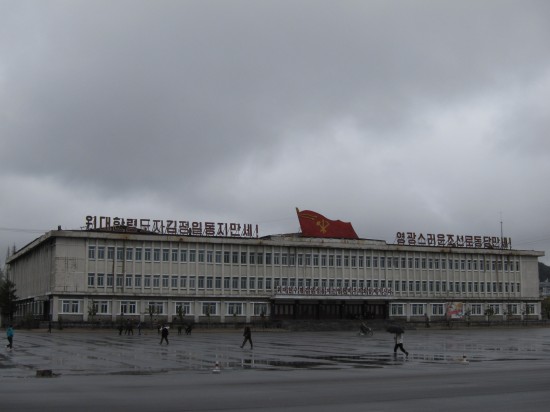
Rason to follow the Singapore model?

P1020173-e1309423116673.jpg

Choson Exchange has been actively promoting in North Korea understanding and knowledge of Singapore's (and other countries') approach to governance and economic/investment policy-making.

According to the Institute of Far Eastern Studies, North Korea's Joint Venture & Investment Commission (a Choson Exchange workshop partner) has said that "Rason will soon become the entrepot port like Singapore, enhancing the lives of North Korean people.”

I look forward to having tasty Singaporean dishes such as char kway teow and Hainanese chicken rice on my next trip to Rason.

Results from June Meetings & Consultations in Pyongyang

We recently completed another round of consultations in Pyongyang and met with the following institutions:

Joint Venture & Investment Commission

IMG_0307-e1309064149956.jpg

1. Confirmed upcoming training program in August 2. Confirmed on-site Pyongyang-based consultant who will be stationed at JVIC for a month in September 3. Confirmed upcoming overseas policy training to be conducted jointly with planning commission 4. Confirmed upcoming overseas program to be attended by senior JVIC leadership 5. Conducted comprehensive discussion of North Korean investment law and its practice 6. Confirmed cooperation agreement

Foreign Trade Bank

1. Confirmed upcoming training program in August 2. Confirmed cooperation agreement

Embassy Meetings

1. Met with ambassadors and embassy staff at three foreign diplomatic representations for briefings and to discuss joint projects

Academic

1. Kim Il Sung University Law School – Consulted professors to understand how legal training is conducted and how law is practiced in reality 2. Pyongyang University of Science & Technology – Consulted professors to understand progress of programs and how we can assist in joint projects

June Trip - Media & Legal Programs

IMG_0220-e1304419380920.jpg

We will be visiting Pyongyang from June 20 to June 25. We will be travelling with a legal workshop leader and a media-related team. Agenda will involve:

1. Discussions on scholarships and overseas programs and selection of people to involve in programs 2. Media visits to a variety of sectors 3. Follow up meetings with investment-policy bodies which will cover:

- Areas of organization value chain we wish to cover in training workshops - Long-term organization plan and where we want to and can add value - Further consultation on aims of organization and seriousness in building the institution - Fixing timeline for September workshops in Pyongyang

and our legal workshop leader as well as to discuss media-related visits

New Photos Added and Snapshots from North Korea

Wonsan

Wonsan

We have added new photos from our last trip to our Facebook page. You will need to access our Facebook page (see box on the right) to see these photos. Unfortunately, we were too busy with work to take a lot of photos, but we have some shots from Wonsan and Nampo (where we visited the port), as well as an unusual bout of snow in the middle of April on the road to Wonsan.

On this trip, I am reminded of how similar Koreans on both sides of the DMZ are. In one meeting, when I asked my counterparts if they could figure out something, a Director laughed and replied that it should not be a problem because "Koreans are very smart people." A very similar refrain I commonly hear from South Koreans.

Looking for Bankers/Entrepreneurs/Ex-Policy Makers/Consultants to Volunteer

IMG_0160-e1304225626547.jpg

We are looking for volunteers with an interest in North Korea and the right skill sets to lead workshops in Pyongyang in the September-October period, and for North Koreans outside of Pyongyang in the July-August period.

Those with the following skill sets would be most appreciated and are welcome to email us at CEteam@chosonexchange.org to discuss volunteering opportunities. Those with relevant experiences outside of these areas are welcome to join our mailing list and Facebook page to stay in touch about future opportunities:

Economic Policy 1. Fiscal & Monetary Policy 2. Business Environment Development 3. Investment Policy & Sourcing

Banking 1. Risk Management - Credit, FX, Market, Liquidity, Operational...etc. 2. Asset-Liability Matching 3. Banking IT Systems

Entrepreneurship 1. Developing Business Plans 2. Feasibility Studies

April 2011 Financial Sector Post-Trip Report

IMG_0133-e1304139772142.jpg

We completed a round of consultations with the financial sector and investment policy sector in North Korea in April. We have attached non-sensitive and non-confidential details from the trip below. We do not vouch for the veracity of comments of participants, and details are given as described to us by relevant members of the respective organizations.

For our post-trip report on the financial sector and investment committees, please see "April 2011 Financial Sector Consultations."

Sections:

1. [REMOVED] 2. [REMOVED] 3. Daesong Bank 4. Kim Il Sung University Financial College 5. Foreign Trade Bank 6. Joint Venture & Investment Commission 7. Daepung Group & National Development Bank

New Addition to Risk Management/Economist Team

DSC00506-e1303652729354.jpeg

We would like to welcome our latest addition to the team as we expand our Risk Management/Economist workshop leader team in preparation for programs in July, August, September and October in Pyongyang and elsewhere. We appreciate Gregory Levin for his valuable time and expertise that he will contribute to our mission.

Greg's Bio:

Greg is an Asia country risk analyst and economist for a major U.S.-based financial institution. In recent years, he worked in various roles related to foreign exchange trading and market analysis for the Federal Reserve Bank of New York as well as a major economic advisory firm in New York City. He previously helped co-start a firm to attract investment into Chinese infrastructure projects in Shanghai. Greg has a masters in international economic policy from Johns Hopkins University School of Advanced International Studies (SAIS). He also attended Nanjing University for a one-year certificate program in Mandarin Chinese, and received his B.A. in Chinese Studies from Connecticut College.

April Financial Sector Consultations in Pyongyang

DSC00555-e1302538317472.jpeg

We will be bringing a team to Pyongyang for consultations and discussions on financial sector development from April 16 onwards for 2 to 3 weeks. For these consultations, we arranged to meet with the following institutions:

Kim Il Sung University Finance College Korea National Development Bank Daesong Bank Foreign Trade Bank Daepung Group Joint Venture & Investment Commission

International Section, Worker's Party

New Lecturer in Exchange Rate Policy & Financial Sector Policy in Singapore

As we prepare programs to launch in Singapore, we are glad to welcome Professor Charles Adams who will assist us in his personal capacity as a former IMF official who possesses expertise in exchange rate policy and financial sector polices - key areas we are emphasizing in our programs. His bio is as follows: Charles Adams’ research areas include exchange rates; financial market developments and issues; monetary policy formulation; and regional economic integration and co-operation. He has published widely in various journals and recently co-edited a book on financial and corporate restructuring in the aftermath of the Asian crisis. For close to 25 years, Charles Adams was an official at the International Monetary Fund (IMF) where he worked on the IMF’s World Economic Outlook and International Capital Markets Reports and was, until last year, Assistant Director at the IMF’s Regional Office for Asia and the Pacific located in Tokyo.

During the last few years, he represented the IMF at regional policy meetings of APEC, ASEAN, ASEAN +3, EMEAP and SEACEN and also represented the IMF on the Financial Stability Forum Working Group on Highly Leveraged Institutions. Since leaving the IMF, Charles Adams has been a visiting professor at Singapore Management University and a consultant in the Office of Regional Economic Integration at the Asian Development Bank.

Banking & Finance Resource for North Korean Students & Professionals

Photo courtesy of the Korea Economic Institute. Compiled by Greg Levine Economist at a major global commercial and investment bank

Photo courtesy of the Korea Economic Institute. Compiled by Greg Levine Economist at a major global commercial and investment bank

The following is a resource guide on learning about the banking sector which we compiled for North Korean students studying overseas as well as for our in-country programs.

Issue of bank assets and asset management

The Bank for International Settlements has an excellent website for free research on developments in bank asset management. (http://www.bis.org/)

Some good papers of possible interest:

"Sound credit risk assessment and valuation for loans" (http://www.bis.org/publ/bcbs126.pdf)

"Supervisory guidance for assessing banks’ financial instrument fair value practices" (http://www.bis.org/publ/bcbs145.pdf)

The Euromoney website offers some good information on many of these topics as well. (http://www.euromoney.com/)

A summary "How to" guide on bank liquidity management.

(http://www.euromoney.com/images//502/77344/Liquiditymanagement_sept10_WEBFINAL.pdf)

The NY Federal Reserve has a very good website with dozens of topics related to banking, supervision, and asset management. (http://www.newyorkfed.org/index.html)

Their report on foreign exchange risk management might be good for banks with extensive foreign exchange exposure.

- "Management of Operational Risk in Foreign Exchange" (http://www.newyorkfed.org/fxc/2004/fxc041105b.pdf)

Issue and trade of stocks, asset investment, securitization, fundraising and management

Investopedia is a good investor site. They have good basic articles on trading stocks, characteristics of the market, and other assets. (http://www.investopedia.com/)

Their "investing basics" article has a good overview that links to many other articles: http://www.investopedia.com/articles/basics/

Types of bank loans, collaterals and guarantees

Very basic background on bank loan types. (http://www.ehow.com/about_4672890_types-bank-loans.html)

A short introduction on defining bank debt. (http://www.ehow.com/about_7237606_define-bank-debt.html)

[this topic can get complex, but the Federal Reserve site has some articles on this as well; let me know if you have any questions]

Law and regulations concerning bank management

The Federal Reserve publishes regulations on bank services based on U.S. law. This site is huge but can be useful if you have a detailed question in mind. (http://www.federalreserve.gov/bankinforeg/reglisting.htm)

Accounting principles concerning bank and its financial statement

Basic accounting information and overview can be found at a free online accounting textbook. (http://www.principlesofaccounting.com/chapter1/chapter1.html)

Issuing of banking cards and its settlement system

A good background on credit cards and settlement systems: (www.cardpaymentsolutions.com/docs/Bankcard_101.doc )

For more details on settlement systems and developments, you can reference the BIS website:

"Principles for financial market infrastructures - consultative report" (http://www.bis.org/publ/cpss94.htm)

Bonds trading on international financial market

Wikipedia has a good overview of the bond market here: (http://en.wikipedia.org/wiki/Bond_market)

For details, try Securities Industry and Financial Markets Association (SIFMA). The SIFMA site is excellent and provides data as well as reports and educational material. http://www.sifma.org/research/

Their page on bond markets might be very useful for you:

http://www.sifma.org/Education/Industry-Basics/Capital/Securities/

A few more sites you might be interested in ...

McKinsey & Co. offers an interesting background on Asia banking opportunities. Membership to the site is free, and they provide regular emailed reports on industries if you sign up for them.

https://www.mckinseyquarterly.com/PDFDownload.aspx?ar=2763&srid=17

Their recent article on "Asia's $1 trillion infrastructure opportunity" gives some basic infrastructure / financing principles along with some of the opportunities being looked at these days in Asia.

https://www.mckinseyquarterly.com/PDFDownload.aspx?ar=2765&srid=17