

Borderland Cafes (or "we're not obsessed with coffee, but...")

Yanbian Autonomous Prefecture in China is a fascinating place. Its major city, Yanji, has experienced a huge economic boom in recent years. Connections with wealthy South Korea grow every year, new apartment blocks are springing up everywhere and it is soon to be connected to high-speed rail. In the area, three or four distinct Korean cultures intermingle: Korean-Chinese from the prefecture, Korean-Chinese from outside, North Koreans and South Koreans.
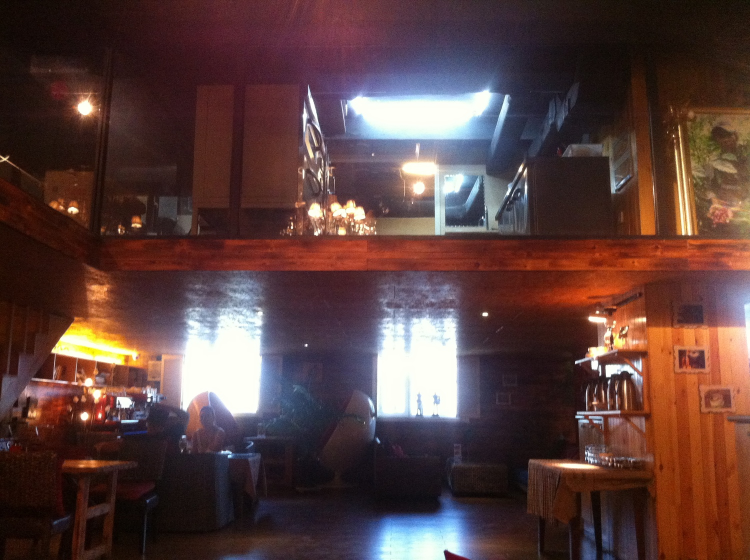
Gabeeyang interior and baking cubby hole

Gabeeyang interior and baking cubby hole

It is largely due to the latter than Yanji is probably the best coffee town in China, with roasters, specialty shops and huge student hangouts: cafes the size of basketball courts. Its a region where you won't find a Starbucks, but you can find yourself a hand-drip cup of Sidamo, when in season.

If you happen to be in the area, say, in order to run Rason's first ever business workshop last month, you should consider getting your coffee-fix on the border. Coffee in Rason has yet to impress (not the greatest of its issues, though).

Yanji has a broad selection of cafes, too numerous to list here, but the standout for this bean-hound* is Gabeeyang Cafe, an outpost of a very small South Korean chain. 

Uni students: their expressions don't reflect the quality of the choco-caramel whatevers they were drinking.

Uni students: their expressions don't reflect the quality of the choco-caramel whatevers they were drinking.

They have outstanding, bright, fruity espresso shots, a selection of single-origin cafes and all the K-pop you can handle. They roast on-premises. Gabeeyang is located just east of the Yanbian University, below Gina's Place, a popular western hangout with a menu that reminds you of food you liked back home.

Other noteworthy mentions in that neighborhood are the massive Wan Cafe, right across from the university main gate, and a Hands Coffee, a block west of that.

Some 45 kilometers away, one finds Tumen City, which now boasts a handful of coffeeshops, having only gotten streetlights a few years ago. It has a small town feel that most of us don't experience regularly in China and has turned itself into a DPRK-watching tourist destination, from which you can peer across at the denizens of Namyang going about their lives.

This chap recommends a wide stance for North Korea watching - Namyang sits quietly across the river.

This chap recommends a wide stance for North Korea watching - Namyang sits quietly across the river.

There are two more Hands coffeeshops in town, further outposts of a growing South Korean chain that usually features a distinctive yellow and purple LA-lakers decor (which sounds ugly, but isn't so bad). 
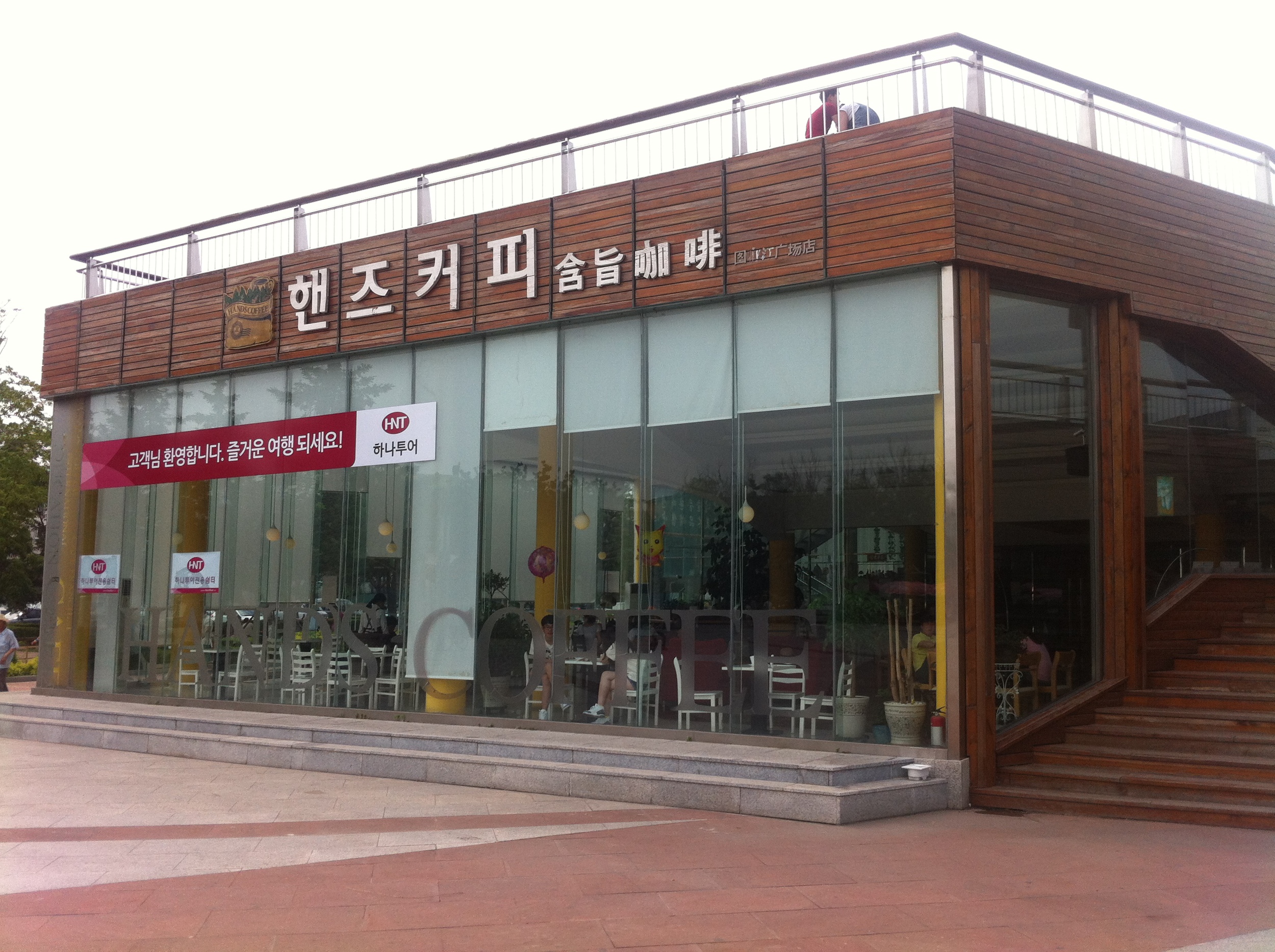
Big Hands

Big Hands

There are two more Hands coffeeshops in town, further outposts of a South Korean chain that seems to be anchoring in Yanbian for its China-franchising strategy.  The bigger of the two has pride of place on a recently developed public square right by the Tumen river. 

It actively courts the South Korean tourist won and provides views of Korean mountains and the banks of the Tumen River. The space is well designed for its purpose, with high ceilings and an entirely glass facade.

There are also three Hands cafes in Yanji and at least one in Longjing, another border town. They all serve the same quality, dark roasted blend that provides a solid, traditional Italian style espresso. Crucially, they also do refills. 

The vocational school that houses Green Apple

The vocational school that houses Green Apple

.Also in Tumen is the Green Apple Cafe, run by the avuncular Bob Granger. It is attached to the Tumen River Vocational School, which was set up by a Christian group to provide education to under-privileged Korean-Chinese students.

South Korean Tourists Welcome!

South Korean Tourists Welcome!

If you want run into one of the six western expats in Tumen (seriously), this is the spot. The coffee here tasted somewhat less curated than in other Yanji cafes, but the fresh-baked breads and pastries would best most in the region.

One should note, again, that to find three cafes in a Chinese backwater of less than 150,000 people is remarkable. It seems incongruous that there are bubbles of bourgeois cosmopolitanism in a place that in some ways is so utterly provincial and has some of that unruly energy one finds in borderlands all over the developing world. Yanbian has had a front-row seat for much of modern Sino-Korean history, with colonial migrations, wars, famine, cultural tensions, North Korean refugees and finally, the kind of economic growth that allows middle class travelers to enjoy an espresso in the morning. One hopes the demographic of locals that can afford such treats continues to expand. Even if they're ordering choco-caramel frappes.

Green Apple Interior

Green Apple Interior


*I know, I know.

Bringing Women in Business Abroad

Preparing to present a business concept

Preparing to present a business concept

Roughly half of our programs focus on policy issues, while the other half focuses on entrepreneurship and business innovation, particularly among females in the small and medium enterprise segment. We recently concluded an overseas workshop for our cherished Women in Business program, in which eight participants we selected from two workshops in Pyongyang came to Singapore. They spent two weeks learning about international business norms and different business concepts inside and outside of the classroom.

Significant logistical challenges exist in organizing a program overseas and these challenges raise the complexity of matching program content with participant needs. For example, we get to know candidates through interviewing and selecting them in North Korea. This begins a relationship and ensures that we understand candidates’ areas of interest. However, when a program takes place overseas, travel dates for North Koreans can shift at the last minute, or a minority of participants are unable to get a visa to travel, sometimes resulting in a mismatch of topics with participants, as the program has to be prepared in advance of these last minute changes.

Because of the logistical uncertainties imposed by onerous travel regulations, and the possibility of last minute shifts in program dates, we normally only start preparing for a program after receiving an email confirmation of the participants who will be attending (normally around 1 month before the actual program). This leads to a short time frame to scramble together a cohesive program, prepare materials and find relevant workshop leaders. This year, we looked at increasing the experiential portion of our overseas programs. Instead of having more lectures, we wanted to the Koreans take advantage of the rare opportunity to be abroad by exploring the environment in order to draw insights from their own observations.

Our volunteer, Desmond, currently studying at the Harvard Kennedy School of Government, put together a retail research project where participants had to visit various shops and analyze it using basic business frameworks (for the business-inclined, this was the 4Ps and 5Cs). They then used their findings to create a retail concept, which they presented. We were surprised at how excited participants were by the group project, putting together complex logos, brand slogans, and in one case recording a voice-over to accompany the unveiling of the brand. This sort of pedagogy is rarely heard of in the DPRK.

At the end of the program, we gathered feedback. Satisfying a diverse group of North Korean participants is always a challenge. They do not seem to understand opportunity costs: an ideal program that satisfies everyone would have more breadth (e.g. more marketing, finance, or human resources depending on the individuals’ functional interest), more depth (e.g. deeper dive into marketing), and more sightseeing. And of course, as busy businesswomen, programs also have to be short so that they can get back to work. So we have a limited number of hours in which participants want to do basically more of everything, and still have enough time to sleep.

A striking paradox we observed is that participants do not ask as many questions at workshops outside of North Korea as they do in North Korea. Our initial hypothesis is that when overseas, the relative value to Koreans of spending another hour in the classroom versus having the opportunity to walk around and observe things dis-incentivizes classroom-based learning.

Another cultural difference we found was that some participants associate learning with listening to a difficult topic they do not understand. If they get a concept after one session, then it must have been too simple!

The highlight to me of the program was the last session we had - a facilitated discussion on female entrepreneurs. Wenchi, a friend from Taiwan, who at one point was a senior advisor to Hilary Clinton on women’s issues, talked about how female entrepreneurs in most parts of the world faced four challenges: access to financing, access to markets, capacity building and leadership exposure. She pointed out that many of these challenges could be overcome through women’s business networks and mentoring programs. In fact, much of the most practical and useful knowledge women managers require in North Korea can probably come from their own successful businesspersons! What they need is a platform for these people to share their experience.

Participants appeared eager to see these opportunities develop. Given the resources required for an overseas program, we are always seeking alternatives that will allow us to more effectively help women entrepreneurs grow their SMEs. More in-country programs focused on networking and mentoring could be such an alternative. We are thus considering making the Women in Business program exclusively an in-country program.

I have to admit that after a full month of preparing and implementing this segment of the program, it is easy to feel burned out by the experience. At least the Choson Exchange team will have a few weeks to recover before our next program...

DPRK Embassy Beijing Consular Section Opening Hours

It's hard to find the opening hours to the DPRK embassy in Beijing if you search the web. These are the opening hours as of 2014:

Monday and Friday - 9:30-11:30 a.m., 2:30-5:30 p.m.

Tuesday, Wednesday, Thursday - 9:30-11:30 a.m.

Photo by Felix Glenk

Photo by Felix Glenk

Rumors have it that the embassy's consular section is sometimes open on Saturday morning, but not always.

The embassy's consular section is located in Cao Fang Di, between the Utown and Parkview Green malls.

JVIC and SEDC to be merged

We told you so in March.

"Given the fluid institutional basis for many of the new economic institutions in North Korea, it is even possible that the SEDC and JVIC could be merged again at some point in the future."

Short answer: we think this is a good thing. Investor agreements, 'exclusive' rights and attraction need to be streamlined to prevent multiple 'exclusive' rights being sold. While this can bureaucratize the investment process, things really can't get more bureaucratic than it is now in North Korea.

The news:


Ministry of Foreign Trade Reorganized as Ministry of External Economic Affairs

Pyongyang, June 18, 2014 20:58 KST (KCNA) — The DPRK decided to reorganize the Ministry of Foreign Trade as the Ministry of External Economic Affairs of the DPRK by merging the Joint Venture and Investment Commission of the DPRK and the State Economic Development Committee of the DPRK with it.

The Presidium of the DPRK Supreme People's Assembly promulgated a decree in this regard on Wednesday.

A New Design for North Korea

The recent collapse of a building in Pyongyang’s Phyongchon District has drawn attention to North Korea’s design and construction industry. The industry has undergone significant changes which may signal a long-term trend towards global norms.

Two days after the building’s collapse, Ma Won Chun, a reputable North Korean architect with experience in finance, was appointed to lead the new ‘Designing Department’ housed within North Korea’s National Defence Commission (NDC).

While it remains to be seen who will be punished for the building’s collapse, Pyongyang’s media response surprised many outside observers — the admission of fault was unusual. The official Korean Central News Agency (KCNA) broadcast self-critical apologies by North Korean officials. With something of this magnitude, the authorities had to get ahead of the story domestically. Rumours can spread nationwide and failing to address the outrage of the most important constituency — Pyongyang — could have been risky.

But the government’s response to the building’s collapse also seems to fit with a wider trend. Pyongyang appears to be strategically aligning its design and construction industry with global trends and norms. Ma’s appointment can also be seen as part of this trend. Some commentators have remarked that Ma’s appointment together with the creation of the new Designing Department could have been a direct response to the incident. If so, that would be an incredibly rapid response.

"Civilized Socialist County" - Construction Projects have feature prominently under Kim Jong Un

"Civilized Socialist County" - Construction Projects have feature prominently under Kim Jong Un

The organisational structure of the Designing Department, which consolidates the design and construction process and controls teams of soldier builders, is similar to the design-build project delivery system — a globally popular construction delivery method. This system calls for the management of design and construction by a single entity, which, in principle, can result in greater efficiency and better integration between different stakeholders in the project.

Other attempts at improving coordination in construction are apparent in organisational and technological changes.

The dissolution of the Capital City Construction Commission in April, though believed to be politically motivated by Jang Song Thaek’s purge, has been important in removing the organisation’s overlapping functions with existing ministries.

Also, according to an architect during a Choson Exchange visit, the design and construction industry is experimenting with the process of Building Information Modelling (BIM), a tool for integrating construction information between different stakeholders of the project.

There is also a growing interest in design, as witnessed in the development of landmark projects, such as the Masikryong Ski Resort and Munsu Water Park. Another example is the elevation of Pyongyang University of Architecture to a ‘general university’ in November 2013, making it the fourth university in the country to enjoy this status. Several designers educated abroad have also been exposed to new design tools and knowledge that can be applied in North Korea.

So, what do these general trends and the appointment of Ma Won Chun as the leader of the Designing Department in the NDC mean for North Korea?

First, having a central authority preside over design and construction units in the country may reduce inter-ministry rivalry and improve the coordination, efficiency and quality of construction projects. This is especially important within the context of attracting foreign investors to develop North Korea’s new special economic zones. Perhaps more than political shifts at the top, what these investors are concerned with is the smooth delivery and quality execution of projects. This requires reliable, efficient and well-coordinated local partners on the ground.

Second, with the state´s increasing desire to develop tourism products, devoting more attention to design is important for creating a suitable environment and ‘experience’ for tourists, which are lacking in current resorts. The new department in the NDC seems to signal the growing importance of design at a strategic level. However, the success of its strategic goals will also need to be complemented bytraining and exposure to global design standards for people on the ground.

Although the Designing Department in the NDC is too new to be accurately evaluated, its creation and the appointment of Ma Won Chun seem to reveal that things are at least starting to move in the right direction for North Korea’s design and construction industry.

This article originally appeared on the East Asia Forum Website.

Czech Beer and Russian Cuisine in Rason

Do you like Czech beer? Do you like Russian food? Well, by golly, then Rason is the place for you!*

Two new (as in, within the last year) dining establishments are now lighting up the Rason restaurant scene, serving European treats. This is a welcome break from the Sinified Korean food that has dominated Rason since...a long time ago. (Indeed, one CE workshop leader who had previously fallen in love with Pyongyang style hot-plate tofu was regularly disappointed to find Chinese-style tofu appear whenever we attempted to order it.) 

The Russian Place

We're not sure what this place is called, as we don't speak Russian, but let's temporarily dub it "Mustachioed Construction Worker", after the several muscular and mustachioed Russian laborers we saw working on the Russian-leased pier at Rajin port. Indeed, their constant presence over the last several years as the rail link and then the pier were developed is the impetus for the founding of this restaurant. And while they would likely be the main clientele, the restaurant does have a Chinese/Korean food section as well.

Mustachioed Construction Worker (Probably)

Mustachioed Construction Worker (Probably)

The bread and cheese is a highlight here, as well as Russian dumplings, which were quite good but were probably imported frozen.

Dumplings

Dumplings

Tables less fenced off than in normal Northern restaurants

Tables less fenced off than in normal Northern restaurants

Mokran Video (the state video distribution company) seems to be releasing more and more Russian material these days. With some Slavic tunes in the background, the ambiance does serve to transport one away for a spell.

The Chesko Beer Place

Some strange interior features

Some strange interior features

following the northern rendering of 'Czech', "Chesko Beer Place" is what everyone calls this restaurant. No wonder the generic name, as they don't have any signage. They do serve beer, however. It seems a Czech gentlemen was under contract to train the staff to make beer, but recently left.

It is situated in Rajin on the edge of a city park overlooking the sea and they don't mind you dragging a seat out in the afternoon to enjoy the leafy view. This is a significant improvement on the interior, which has a weird plastic jungle/orchard vibe.

The food menu is not terribly Czech, or really Czech at all - it features the pretty standard Chinese-Korean mismash.

Freshness

Freshness

What kind of beer do you have, asked I. Chesko, said they.

What kind of beer do you have, asked I. Chesko, said they.

The beer itself is also not terribly Czech, its flavor profile having been made a bit softer and lighter for local palates. It is very drinkable and smooth, though: its so fresh and bright, it makes a nice beer for summer.  It's competitively priced with other restaurants, with a 500cc glass going for 10 RMB and a 300 cc glass going for 8 RMB.

*some caveats apply

4th Annual Rason Trade Fair Dates: August 18th to 21st

Choson Exchange, in cooperation with Hanns Seidel Foundation, just conducted the first ever economic workshop in Rason. More on that soon.

For now, another first (at least as far as my google-fu can reveal): we can announce the dates of the 2014 Rason Trade Fair, set for August 18th to 21st. Interestingly, this was among the many issues we covered when it comes to investor relations during our two-day program: people need more than 6 weeks to prepare for a trade fair. Six weeks! That's tough enough to plan travel, much less plan a decent booth.

Regardless, hot off the presses is their flyer, reproduced below. Feel free to print and fold accordingly.

Front and Back

Front and Back

Delicious Filling

Delicious Filling

The Complete Guide to North Korea Investment Laws

Our regional representative, Ryan Russell, an international lawyer, recently posted a compiled set of North Korean (DPRK) investment laws. This was published before North Korea's Special Economic Zone (SEZ) policy was announced, and it is likely that incremental changes will be made to existing investment laws to reconcile it with the latest zone guidelines. Contents at Ryan's blog include:

PART I – FOREIGN INVESTMENT

01 – Law of Foreign Investment

02 – Law on Equity Joint Venture

03 – Law on Contractual Joint Venture

04 – Law on Wholly Foreign-Owned Enterprises

05 – Law on Foreign-Invested Banks

06 – Law on Registration of Foreign-Invested Businesses

07 – Accounting Law for Foreign-Invested Businesses

08 – Law on Financial Management of Foreign-Invested Enterprises

09 – Labour Law for Foreign-Invested Enterprises

10- Taxation Law for Foreign-Invested Businesses and Foreign Individuals

11 – Bankruptcy Law for Foreign-Invested Enterprises

12 – Law on the Rason Economic and Trade Zone

13 – Law on the Hwanggumphyong and Wihwado Economic Zone

14 – Regulations on Establishing and Operating Foreign-Invested Law Offices

15 – Regulations on the Naming of Foreign-Invested Enterprises

16 – Audit Regulations for Foreign-Invested Businesses

PART II – EXTERNAL ECONOMIC MATTERS

17 – Law on External Economic Contracts

18 – Law on External Economic Arbitration

19 – Law on External Civil Relations

20 – Civil Procedure Law

21 – Law on Compensation for Damage

22 – Notary Public Law

23 – Inheritance Law [Succession Law]

24 – Customs Law

25 – Immigration Law

26 – Law on Health Quarantine on the Border

27 – Law on Quarantine Inspection of Animals and Plants on the Border

28 – Law on Foreign Exchange Control

29 – Law on Commercial Banks

30 – Law on the Prevention of Money Laundering

31 – Insurance Law

32 – Law on Land Lease

33 – Foreign Trade Law

34 – Law on Processing Trade

35 – Law on the Chanmber of Commerce

36 – Law on the Origin of Exports

37 – Law on the Inspection of Export and Import Commodities

38 – Invention Law

39 – Copyright Law

40 – Trademark Law

41 – Law on Industrial Designs

42 – Law on the Name of Origin

43 – Law on the Protection of Computer Software

44 – Law on the Protection of the Environment

45 – Law on Environmental Impact Assessment

46 – Law on the Prevention of Seawater Pollution

PART III - MT. KUMGANG SPECIAL ZONE FOR INTERNATIONAL TOURISM

47 – Law on the Mt. Kumgang Special Zone for International Tourism

48 – Tourism Regulations in the Mt. Kumgang Special Zone for International Tourism

49 – Regulations on the Establishment and Operation of Businesses in the Mt. Kumgang Special Zone for International Tourism

50 – Customs Regulations in the Mt. Kumgang Special Zone for International Tourism

51 – Regulations on Entry, Exit, Stay and Residence in the Mt. Kumgang Special Zone for International Tourism

52 – Taxation Regulations in the Mt. Kumgang Special Zone for International Tourism

53 – Insurance Regulations in the Mt. Kumgang Special Zone for International Tourism

54 – Regulations on the Protection of the Environment in the Mt. Kumgang Special Zone for International Tourism

Our volunteer Peter, an international lawyer with experience in China, has previously analyzed on DPRK investment laws.


3Ps of Japan & North Korea Negotiation – Process, Price & Priorities`

Following Foreign Ministry talks in Sweden, North Korea has agreed to reinvestigate the cases of Japanese abductees, and Japan has pledged to remove some sanctions and offer humanitarian aid conditional on progress on the issue. While official talks were only announced on March 20, you can be sure that Japanese negotiators have been steadily working on the issue for the last 2 years ever since Shinzo Abe assumed the Premiership (and maybe even before). It also seems that Japan has been waiting for North Korea’s intelligence arm (Ministry of State Security) to reach out, to be assured that North Korean negotiators in Sweden have the authority to conclude a deal.

Given that the Japanese have been trying to untangle this issue for more than a decade, what continues to stand in the way, and why are things moving now? 3 Ps are important in understanding the issue:

Process

The last visit fell apart when Kim Jong Il admitted that kidnappings happened, apologized and offered to allow some of the abductees to visit their relatives (being assured that they would return to North Korea). The abductees never returned, and among the remaining abductees that North Korea admitted to, North Korea claimed that they had passed away. The Japanese public rejected the deal with North Korea, and both Koizumi and Kim Jong Il walked away from a failed process. Both sides took significant risks to make a deal happen. For North Korea, the admission splintered their supporters in Japan.

Both sides recognize that the next deal has to be the last deal on the issue, in that the Japanese public has to be certain that all abductees are accounted for, or the negotiations will collapse again. This is not a trivial obstacle. First, there is the question of verifying and confirming if the abductees claimed to be dead are truly dead. Second, there is no agreement on both sides on the true number of abductees. Third, it has to be assumed that any abductees (and their families) must be given the option of moving to Japan.

To placate the Japanese public, a process has to be created to ensure that the issue is addressed conclusively. There might even be a need on both sides for an ‘honest broker’ who can mediate between rival claims. As yet, neither side has seen the need to draw in a third party. Internally, North Korea will run up against vested interests in its investigation, as people could be made to assume responsibility for the kidnappings. Or maybe they could just lay that responsibility on some recently deceased uncle…

Price

North Korea seeks reparations for its colonization by Japan. In the case of South Korea, Japan has paid reparations for its colonization period. While both sides dance around the amount, using a mix of principles and figures raised in past negotiations in their arguments, this will at the end of the day be a realistic and necessary lever to get North Korea to agree to a resolution on the abduction issue.

For a North Korea beginning to think more about economic development, Japanese aid and investment is critical. Rapprochement with Japan could also pressure South Korea to engage more with North Korea. In fact, North Korea’s significant state investment in tourism facilities in Kangwon province (think Wonsan beach resorts, Sinphyong, Masikryong ski resort…etc.) seem strategically positioned to attract Japanese and South Korean tourists in the event of rapprochement. Perhaps a Japan-DPRK summit in Kangwon province (Masikryong or Wonsan), could be a good way to kick-off a potential epicenter of DPRK-Japanese grassroots and economic interactions in the future.

Priorities

Why are things moving under Shinzo Abe? Aside from the stability of his government, Shinzo Abe has been at the forefront of the abductee issue for more than a decade. Traditionally, abductions, North Korea’s missile program, and nuclear program, form an unholy trinity of obstacles between Japan and North Korea. Abe’s personal identification with the abductions, and drive to resolve it, has pushed abductions ahead of other DPRK-Japan issues.

For Japan, putting all three issues on the same level does not make sense, as the missile and nuclear issues cannot be solved bilaterally without US and South Korea at the table;  both allies have at times considered Japan’s obsession with abductees an idiosyncratic or at least peripheral complication in past negotiations. At the same time, there could be constituents in Japan who worry about how a bilateral deal deprioritizing the nuclear and missile program could affect the US-Japan alliance.

Politically, its clear how there is an opening for North Korea with regards to Japan. What is more opaque is how and whether domestic politics in North Korea is creating a reciprocal opening for Japan in North Korea. Either way, a deal can be in both countries’ interests, and more broadly beneficial to regional peace and security. 

Overheard at SEZ workshop: "People are here to learn"

Someone explain to me who put the windmills in Suzhou Industrial Park?

Someone explain to me who put the windmills in Suzhou Industrial Park?

Last month, we ran a workshop on Special Economic Zones in Wonsan, with people from 5 provinces attending. Workshop leaders were practitioners, focusing on the nuts and bolts from an investor perspective, rather than on academic theories on SEZs. One such practitioner, a British with over 15 years of experience investing in North Korea, shared Singapore’s experience developing the Suzhou Industrial Park (SIP) in China. He was a big fan of the project, and called it the “go-to place for businesses looking to set up in China.” He also spent considerable time explaining Irish SEZs, which he also recommended as another model for North Korea to study.

The $30B SIP generated significant controversy in Singapore in its early years. Local Chinese officials undermined the project by building a competing park next door. From a financial point of view, the project lost money in its early years. But as a special zone, it established its reputation as a good location for businesses.

Perhaps in Singapore, lessons from this experience laid the foundation for future projects. The experience definitely did not deter Singapore from getting involved in developing a string of industrial parks, high-tech zones and other SEZ-type projects in India, Vietnam and China. SIP is more relevant to North Korea than Shenzhen, given that the sizes of the proposed SEZ corresponds more to an industrial park than to an entire region.

Singapore’s experience from these projects will be highly relevant as North Korea continues to focus on developing its SEZs. A Singaporean friend who visited North Korea in 2009 mentioned how the government officials he met had studied SIP and quizzed him about Singapore's experience developing it. It is this practical knowledge, good managers, and strong political support that is very much needed to ensure SEZs in North Korea stand a chance of taking off.

We hope to see more efforts by North Koreans to send their SEZ managers overseas for extended training and research and would like to support them in doing so. We have often pressed our partners on the need for DPRK policymakers to focus not just on the short-term, but understandably urgent, goal of attracting investments, but also on laying a proper foundation by ensuring that their managers are well-equipped with international knowledge and experiences. Frequently, we fail to recruit the best managers for long-term scholarships, as their organizations need them for more immediate projects. At the national level, we have yet to see significant efforts made to ensure the process for sending people abroad for programs is more easy, efficient or transparent.

And the best part of the workshop last month? A workshop leader who was terribly cynical about the SEZ effort felt he was self-censoring. He did not think the investment conditions or infrastructure was anywhere near ready for foreigners, but did not want to be brutally honest. We brought his concerns to a young Korean partner, who told us that workshop leaders should be direct and honest in replying to questions. “People are here to learn,” he said.

Update: Calvin, our resident urban planning expert, adds:

The main learning points for SIP are strong leadership, good management, strategic implementation in phases. Physical scale wise, SIP is almost a city / region actually, much larger than other typical industrial parks developed by Singapore and even Kaesong.

SIP: 8000ha

Bintan: 270ha

Wuxi: 340ha

Batam: 320ha

Kaesong: 300ha approx.

Calvin previously wrote a post comparing Rason and SIP.