New Year, New Sanctions, New Breakthroughs

Unfortunately for those of us concerned with the DPRK, the breakthrough was between the US and Cuba. 

Two weeks after the historic announcements by Raul Castro and Barak Obama, President Obama signed an executive order that allows the U.S. Treasury Department to impose new sanctions on targeted individuals and institutions from North Korea, in retribution for the Sony hack. These entities cannot receive aid, nor can they conduct any transactions with U.S. individuals or entities. Ten North Korean government officials and three organisations were targeted. (See here for a full list.)

Critics of Obama predictably (and correctly) noted that this was largely symbolic in nature: the administration attempted to fend off this criticism by stating this action was just the beginning of a bigger campaign.

This is no doubt what worries Pyongyang, which dished out some, ahem, colourful language, including the priceless term, “inveterate repugnancy”. After all, the main entities targeted, the Reconnaissance General Bureau, the Korea Mining Development Trading Corporation, and the Korea Tangun Trading Corporation have almost certainly not been dealing with Americans and certainly are already well versed in flying under the radar. The direct impact of sanctions on these newly listed entities will be small indeed.

It is largely the threat of escalation to which Pyongyang is responding and perhaps the uncertainty of how Obama sees the DPRK featuring in his remaining time in office. If Cuba is a key legacy project for Obama, his administration will have thought through a number of contingencies for the battle over a major Cuba-policy change among more skeptical branches of the US government. Moreover, its widely accepted that Obama feels there is no chance of improving relations with Pyongyang during his remaining years as president. Does he feel he can or needs to ‘get tough’ on North Korea to help deflect criticisms that he’s being soft on Cuba?

The link between the two issues has already been drawn by Democratic Senator Robert Menendez. He, like many Republicans, is predicting Obama will have “a difficult time” getting the legislature to fund a US Embassy in Havana or confirm an ambassador, while calling on the administration to get tougher on North Korea. 

To what degree Cuba and North Korea are connected in the minds of key decision-makers in Washington remains to be seen. Whether there is a deterioration between the US and North Korea in the next two years, or whether (like most cybercrime issues) it is forgotten rather quickly, and US actions remain limited and symbolic, it is a safe bet that there will be no breakthroughs between the two antagonists anytime soon. Meanwhile, American travelers to Cuba will increase and the voices calling for more cultural and economic connections will grow more empowered this year.  Making the tension between Pyongyang and Washington seem all the more archaic.

We would like to note that Choson Exchange actively keeps a list of sanctioned entities and items as noted on the Office of Foreign Assets Control’s Specially Designated Nationals and Blocked Persons List. We take steps to ensure that designated individuals and organizations do not participate in CE programs.

Sony and the DPRK: when will internet come to North Korea?

The Sony Pictures Affair Probably Means Bad Things for Increased North Korean Internet Access.

Reports suggest that North Korea’s already limited access to the internet went black several times this week, as well as perhaps their 3G networkMost analysts suggest it is due to hacking, likely through a DDOS attack. This comes as North Korea is experimenting with more internet access: as much as there is all sorts of fallout on Sony’s end, this will have an unfortunate impact on decision-making in Pyongyang.

We tend to view North Korea’s restrictions on internet accessibility as an issue of social control, which of course it is. However, when you speak to North Koreans, raised in a Garrison State, they often bring up security as the frame through which they view internet access.

After all, the authorities recognize that currently they have a very important strategic advantage over their enemies: their closed systems are far less vulnerable to hacking than are the systems of their enemies, with their sprawling, interconnected systems. And as with so much in the DPRK, the closed nature of their system is a conscious choice to maintain a military advantage at the cost of an economic one.

Yet there are signs of experimentation. It does seem as if more and more companies and organizations are getting online in North Korea in a limited fashion.  Usually this means they have to register in advance for time at a connected terminal and are limited in what they can view. Organizations still tend to have a single email address for the entire staff. There is, however, already awareness that economic success will require more access to information, something we emphasize in Choson Exchange workshops.

Red Star Linux, North Korea’s homegrown operating system, received an upgrade to 3.0 last year, mostly gaining attention for its visual similarities with Mac OSX. We’ve been told this is the most secure version yet: with each round of coding, they will probe for weaknesses and patch them or write new code for the next version. It is, apparently, still not secure enough for them to feel comfortable with allowing broader internet access.   

If one is feeling cynical about it, one might say they never will. After all, a former North Korean IT specialist, now a South Korean professor, has been saying they are on the verge of providing access since 2009. (He also notes that “the most serious anxiety for North Korea while preparing to connect up to the Internet is the potential outflow of North Korean internal information”, rather than harmful inflows.)

If one is feeling less cynical, one could hope that Chinese encouragement might someday pay off. China’s quiet and longsuffering attempt to get North Korea to more closely imitate its model has been occurring at both the working day-to-day level of businesspeople and traders, as well as the highest levels of officialdom.

In dealing with the social-control challenges posed by the internet, China feels it has amply demonstrated that agenda-setting, carefully chosen censorship and flexibility in the official narrative can all be combined to mollify the threats posed by more outside information.  

Going forward, if Pyongyang wanted to open up beyond registered research terminals, the authorities could allow more access, but under a more intense system of restriction than the Chinese currently use. They could, for example, employ a white list for accessible websites, rather than a black list or could allow access through a system of walled applications, rather than relatively open browsers. This could also be supplemented with other software and hardware controls, while still only allowing certain (but more) computers access and keeping a close eye on everything that happens on those terminals in order to keep a lid on ‘harmful information’.

Yet as much as that information is a concern, the continuous nature of electronic warfare is something keenly understood in Pyongyang. Remember the 2009 cyber attacks on South Korea? No? Well, remember the attacks on US military sites emanating from China? You sort of do? It was just last year. But not like you remember Russia foray into Ossetia in 2008 or the US venture into Iraq in 2003, right? The only reason this Sony affair has captured the public imagination is that it is a film studio that produces things that we watch and its unleashed some juicy Hollywood drama.

Cyberwarfare, which is largely without blood and has really disappointing explosions, usually gets a PR pass: in the sphere of public opinion and even diplomacy, there is something allowable about it. Until it really causes a meltdown, it will be a tolerated form of international conflict. (We’ll see if the Sony affair has the potential to change this.) 

Yet cyberwarfare has already proven to be extremely potent. Just ask Iran, which in recent years has both very cheaply brought down an American drone, safely landing it in its own territory and has also seen the Stuxnex worm tear up its nuclear program. And it is precisely this sort of worm that Pyongyang fears and Seoul hopes will increase its asymmetric capabilities.

South Korea played on these fears earlier this year with a public announcement that it is developing a Stuxnet-type worm to attack North Korean nuclear facilities. Let us ignore for a minute the fact that this is a very public announcement, unusual for this sphere of murky conflict. Or that there is a degree of impotence in the statement that noted this is the second part of a two-phase program beginning in 2010, the first phase including “online propaganda operations by posting to North Korean social networking and social media services.” Presumably this has been four years of tweeting @uriminzzokkiri that lol #ROK4lyfe #yolo.

The first phase was apparently intended to be defensive in nature: a response to the hacks in 2009. These saw several South Korean government websites suffer distributed denial-of-service attacks. More seriously, however, a USFK computer was compromised and operational data was obtained by a hacker based in China, it was claimed. Proof of who was behind the series of hacks has not been presented to the public, but North Korea is widely thought to be the culprit. Pyongyang denies this and while a Symantec report on the attacks pins them on a hacking gang called ‘DarkSeoul’, it notes that “nation-state attribution is difficult”. 

Pyongyang must worry about two fronts: social control and military security. The more online North Korean systems are, the more they lose that asymmetric advantage. For Pyongyang, the certainty of this advantage is greater comfort than the uncertain returns of more connectedness. It would be good to hear more voices persuading them that they will not only survive, but will benefit from greater, if strictly limited, internet access. Instead, the Sony affair – specifically the reprisals that will come either from states or hacktivists – will discourage North Korea from expanding internet access.

As for right now, most Pyongyangers know the internet exists, they know everyone else in the world has it and that it is something of a big deal even if they don’t quite grasp just how pervasive and integrated it is into people’s professional and personal lives. A handful of decision-makers do and they also know that it is a military and social control security risk. As long as they see access and security strictly as two sides of a zero-sum coin, you can guess which side they’ll choose.

                                                                                                                             

"Who Exactly is Making Money in the DPRK?"

At CE, we often find ourselves explaining how the DPRK economy is changing. We're often offered the opportunity to give analysis of the attendant opportunities, challenges and issues. We're almost as often asked something like: "Yeah, but who is really making money in North Korea?". Well, here is one company. This article, featured on Xinhuanet, discusses a corporation that deals with North Korean raw materials and is basically a success-story press release. Clearly it's an exercise in self-promotion, but this is refreshing when it comes to North Korea and business. If North Koreans are publicity-shy, all too often foreign actors are as well: part of the process of normalization of business practices in North Korea will require better communication overall.

Tumen Xinhuan Corporation of Jilin Tiesong Group exceeds its annual business goals

Despite Facing the fluctuating market and heavy obligations, Tumen Xinhuan Corporation of Jilin Tiesong Group overfulfills management goals in 2014.

This corporation is a foreign-trade corporation that runs North Korea iron ore, and counts one fourth of the profits of Jilin Tiesong Group. Then this article praises the corporation by describing details of the corporations hard-working. To increase the amount of import, it negotiated with and imported 62,000 tons of iron ore through the North Korea King Kong Trade Company. To develop more importing routes, the corporation signed import contracts with new North Korean customers, including North Korea Metal Import-Export Company, North Korea Five Trade Company, North Korea Xinxing Cooperation Company. This year Xinhuan Corporation imported 210,000 tons of iron ore through North Korea Xinxing Cooperation Company from Nanping Port. To develop ways to create profits, the corporation used advantages of business relations with North Korea Long Yue Shan Trade Company, by paying attention to this Companys management tendency and actively negotiated. Therefore, the corporation imported 2527 tons of steel ingot and created profits of more than 5 million yuan. To find new ways of creating profits, the corporation negotiated with North Korea Forestry Province, and will import timber in winter.  

By December 9, the corporation has revenue of 165,510,000 yuan, which is 110% of annual plan, and profits of 6,070,000  yuan, which is 233% of the annual plan. 

- Link:  http://www.ln.xinhuanet.com/ztjn/sytlj/2014-12/11/c_1113609021.htm

Translation by Wang Xingyu

Comrade Kim Goes Laughing

We all have mothers -- but not all of us have Korean mothers.

“All Koreans in North and South are working tirelessly for reunification,” I’ve heard a northerner state many a time.

To which I will usually nod, trying not to offend.

“What do you think? Is it the same country as ours?” I’ve been asked more than once by a southerner.

In answer, I’ll often say, “some things look exactly the same: ajosshis red-faced and burning through packs of cigarettes, ajummas cackling in groups as they picnic by the river, and students being forced to study harder than is probably healthy to get ahead in life.”

Then I continue, “Man, though, a lot changes in in 70 years. Almost no one remembers a unified Korea directly, and those who do will be dead soon. So much has changed in that time, in such extreme ways. It’s hard to see it as the same culture any more. It’s really different.”

One South Korean responded to this answer with a resigned, tragically Korean summation of the road ahead:

“Fuck,” he said.

What he neatly summarized in a single deflating word was this: “We’re keeping this single culture, one country idea alive, but the longer we let it go, the harder it is to do. We know this. And it hurts.”

Koreans still largely imagine themselves to be part of the same community, which counts for a lot, but it can be depressing to see such different Koreas. It is also hard seeing Koreans on both sides often resorting to negative constructs of valiant struggles against destructive outside forces as a common cultural element, when so many of the rhythms of daily life have diverged so far. The abstract idea of unity gets buried under a landslide of details.

So, it was with some pleasure that I got to rewatch Koryo Group’s excellent romantic comedy, Comrade Kim Goes Flying, this week in Beijing. The film, a joint UK-Belgium-DPRK production, is the fantasy tale of miner who dreams of being an acrobat and through pluck, good fortune and hard work, makes it happen.

Comrade Kim Goes Flying Poster

Comrade Kim Goes Flying Poster

One curious thing, though,  was that I didn’t laugh as much as I did when I saw it two years ago at the Busan International Film Festival, where it showed to a mostly South Korean audience. I wondered why I didn’t find it as funny the second time around, until I realized I was laughing less for this reason: the Korean audience in Busan were in hysterics, and it was infectious. The mostly western audience in Beijing was politely enjoying an anthropological experiment on film, perhaps basking in the vague air of self-congratulation that takes place when watching a film with subtitles.

In Busan, in particular, everything that a meddlesome mother character does was met with peals of joyful guffawing: she doesn’t have that much screen time, but every minute she does have is spent poking her nose relentlessly into her son’s affairs. Mostly, she is keen on she blocking certain romantic options while at other times helping set chances up. At another point, she forces a raw egg-Kimchi juice concoction down her son’s throat as a means of curing a hangover. Friends who have seen it shown in North Korea said a Pyongyang audience was similarly amused.

Before the showing in Beijing, one of the directors, Nick Bonner, said: “We set out to make a girl-power rom com…it was made for a North Korean audience, so please try to set your preconceptions aside.”

And try as we might to do that, the meddlesome mother just didn’t resonate with us. We were not Korean and most of us never had such figure as part of our shared experience. The South Koreans did, however.

As one audience member at the Busan showing Q&A bluntly prefaced his question: “Wow…that was just like my mom.”

Bonner said Comrade Kim was made for a North Korean audience, but really it was for a Korean audience. For this viewer it was a lovely reminder that, despite the myriad differences between the Koreas and the divergence in modern ways of working, living and thinking that have developed over 70 divided years, there are a multitude of little things that have stayed the same. Such as meddlesome mums. And this is a hopeful thing.


CE's second webinar

Back by popular demand, join us for Choson Exchange's webinar on December 10th! You've been reading our blogs, surely you've got questions.*

Curious about Andray's publication on SEZs? 
CE's recent trip to Vietnam? 
How fondue in Pyongyang actually tastes? 

We look forward to hearing from you during live Q&A!

Feel free to email your questions beforehand to: 

Minki@chosonexchange.org

then join us:

December 10th, 2014
Tokyo: 4pm
Beijing/Singapore: 3pm
New York: 2am 
San Francisco: 11pm (December 9th)

RSVP via link below URL: https://attendee.gotowebinar.com/register/8838647783472736769
Webinar ID: 147-829-131


*(alt grammar version: You've been reading our blog, surely: you've got questions)

May 30th Measures and IFES report

Recently, Professor Andrei Lankov wrote an article for Al Jazeera, focused on the not-yet-fully-clear "May 30th Measures", promulgated by the Central Committee of the Korean Worker's Party. This policy remains not fully articulated to outside observers - it has come out in dribs and drabs. Recent commentary suggests it could be significant, though, with a change in farming work unit size (down to 'family size') and a shift to the work unit being able to keep the majority of its production: 60%. This is up from a 30%.

These two details were featured in a September report by Hyundai Economic Research Institute, generating a bit of South Korean media interest by estimating that GDP growth could be 7.5% in the year following implementation of the measures.

Graph from Hyundai Research Institute report

Graph from Hyundai Research Institute report

Also this week a long report by the Kyungnam University's Institute of Far Eastern Studies titled "Conditions on the Korean Peninsula: Evaluation of 2014 and Prospects for 2015" was released, in Korean. This report is quite bullish on the May 30th measures. ("5.30 measures", as rendered in Korean.) 

There doesn't appear to be an English version on the way, so here are some takeaways:

"Economically, by implementing the regional introduction 6.28 and 5.30 measures as a series of economic improvement measures to provide a ‘market economy’ system of their own, we assess that there is a desire to move towards a rudimentary standard for opening and reform."  (경제적으로 ‘6.28  5.30 조치  일련의 경제개선 조치를 취하면 서 자신들만의 ‘시장경제 시스템을 지역별로 도입해 초보적 수준  개혁개방으로 나아가고자 하는 것으로 평가)p. 6-7

"The 6.28 and 5.30 Measures have the goal of raising production standards through expanding autonomy and incentives for farms, factories, industrial plants etc." (6.28  5.30 조치 농장과 공장기업소  생산단위의 자율성 및 인센티브 확대를 통해 생산수준을 향상시키려는 것이 목적) p.7

"The main features of the domestic economic policy of the Kim Jong Un era is limited economic reform through tolerance towards markets and ‘our style economic management methods’ (i.e. the 6.28 and 5.30 measures)." 김정은 시대 대내 경제정책의 주요 내용은 시장에 대한 관용과우리식 경제관리방법(6.28 5.30 조치)’ 통한 제한적 경제개혁 등임. p. 19

They note it is a ‘limited reform’, writing that “through the so-called 6.28 and 5.30 measures they plan to run a new improved economic management measures step-by-step and gradually." (이른바 ‘6.28 및 5.30 조치’를 통한 새로운 경제관리개선 조치는 느슨하지만 점진적이고 단계적으로 진행) p. 19

Their positive assessment is that: "What is known about the contents of these measures so far is that they are a step further than the 7.1 measures." (이러한 조치는 지금까지 알려진 내용만으로도 7·1조치보다 진일 보한 것으로 평가) p. 19

In terms of their international political-economic position: "while they won’t give up their nuclear weapons, they will push on with diversifying foreign relations in order to build a stable external environment that is needed for attracting foreign investment for economic construction." (북한은 핵을 포기하지 않으면서 경제건설에 필요한 외부투자 유치를 위한 안정적 대외환경 조성을 위해 외교 다변화 추진)

IFES does remain clear-eyed at the end of the day, noting that "<North Korea> will maintain efforts to attract foreign investment into the already named special zones and economic development areas, but the nuclear and human rights issues mean real success is doubtful." (旣 공표한 특구와 경제개발구 등에 외자를 유치하기 위한 노력을 지속하겠지만, 핵과 인권 문제 등으로 실질적 성과를 거둘지는 미지수)p. 29

The 6.28 measures refer to an economic management system declared in 2012. The 7.1 measures refer to not-dissimilar experiments from 2002, largely rolled back a few years later.

New DPRK Website

This VOA article alerted us to the fact that there is a new North Korean website, the aim of which seems to be informing the outside world about society, politics, tourism and perhaps most importantly, the economics of the DPRK.

Of interest to us is the economics page, which has a fairly comprehensive list of the laws and regulations foreigners interested in the DPRK need to know. This is something we've continually impressed upon our audiences in Choson Exchange workshops: that they need to provide more information on the web and provide it more effectively. Finding DPRK laws, regulations and other resources can often be a ponderous affair and this site seems to begin to address this. It will probably also be used to help promote economy-related events; this year, our website was the first to propagate Rason Trade Fairs dates and promotion materials because they simply lacked the outlet to do so themselves. This, of course, is suboptimal.

Interestingly, the tone of the site is less hyperbolic than other official sites out there. It's still distinctly North Korean, but there is less glorification and exaltation about it. It strikes a less combative chord, offering what would read as a more 'normal' resource for introducing a country.

The 'Economy' page of DPRKtoday.com

The 'Economy' page of DPRKtoday.com

Curiously, however, the site is only in Korean. This could mean two things: first, it is solely for the use of overseas Koreans, whom we know North Korean officials hope will help invest in the country the way overseas Chinese did for the PRC in the 1980s; second, they've launched the Korean language site first and will be following up with other languages soon when ready. Let's hope its the latter.

Regardless, it demonstrates a growing awareness that use of and connectivity to the web are crucial to the success of any business venture.

Russia: back

Russia, as we've noted, is back in business in the DPRK: months before being 'lumped together' by the Obama Administration in the wake of the Ukraine crisis, Russia's presence was being felt in Rason with infrastructure projects and across the country with cultural and entertainment products gaining prominence.

Last month, Russia and the DPRK announced a Ruble-trade agreement, under which Russian banks can finance North Korean trade in rubles. Earlier in the year, the process for writing off 90% of of a huge Soviet-era debt owed by Pyongyang was completed by Moscow.

And yesterday, it was announced that the first shipment of Russian coal to South Korea through Rason is going to take place. This is significant as it is a test, essentially, of how willing both Koreas are for Russia to act as guarantor and underwriter for inter-Korean economic projects. Russian dreams of a gas pipeline to the ROK. This is a tiny step in that direction and if coal shipments become regularized after this test, stakeholders in both Koreas could quickly become addicted to the easy cash and cheap fuel that comes out with it.

Pyongyang is pleased to have someone not-China step up as a trading and investment partner, while Seoul is looking for backdoor investment possibilities. It is early days, but this trilateral relationship is now worth keeping an eye on.

A Russian-made Antonov AN-148 on the tarmac at Sunan International Airport on a rainy day&nbsp;

A Russian-made Antonov AN-148 on the tarmac at Sunan International Airport on a rainy day 

The ABCs of SEZs

Yesterday, Andray presented a paper on the Special Economic Zones of North Korea, highlighting their importance for a few reasons as well as making an Oprah joke that only two people really laughed at. The paper outlines some basic features of the new zones created in 2013 and 2014 and highlights four zones that have the best prospects.

Other takeaways on the SEZ policy include: 

•It’s Kim Jong Un’s most visible experiment with the economy and has changed expectations on the ground, creating a positive energy among local officials and businesspeople.

•It offers multiple platforms for further experiments - Rason has conducted a number of experiments over the years, including telecommunications and visa rules, and its possible that other zones will be able to act as platforms for tinkering with some of the rules that currently limit development in the DPRK.

•For Choson Exchange it has opened up new audiences in the provinces and allowed us to interact with a broader range of people.

The full paper is available here. It will make an excellent stocking stuffer for all the family.


Think Big, Focus Small

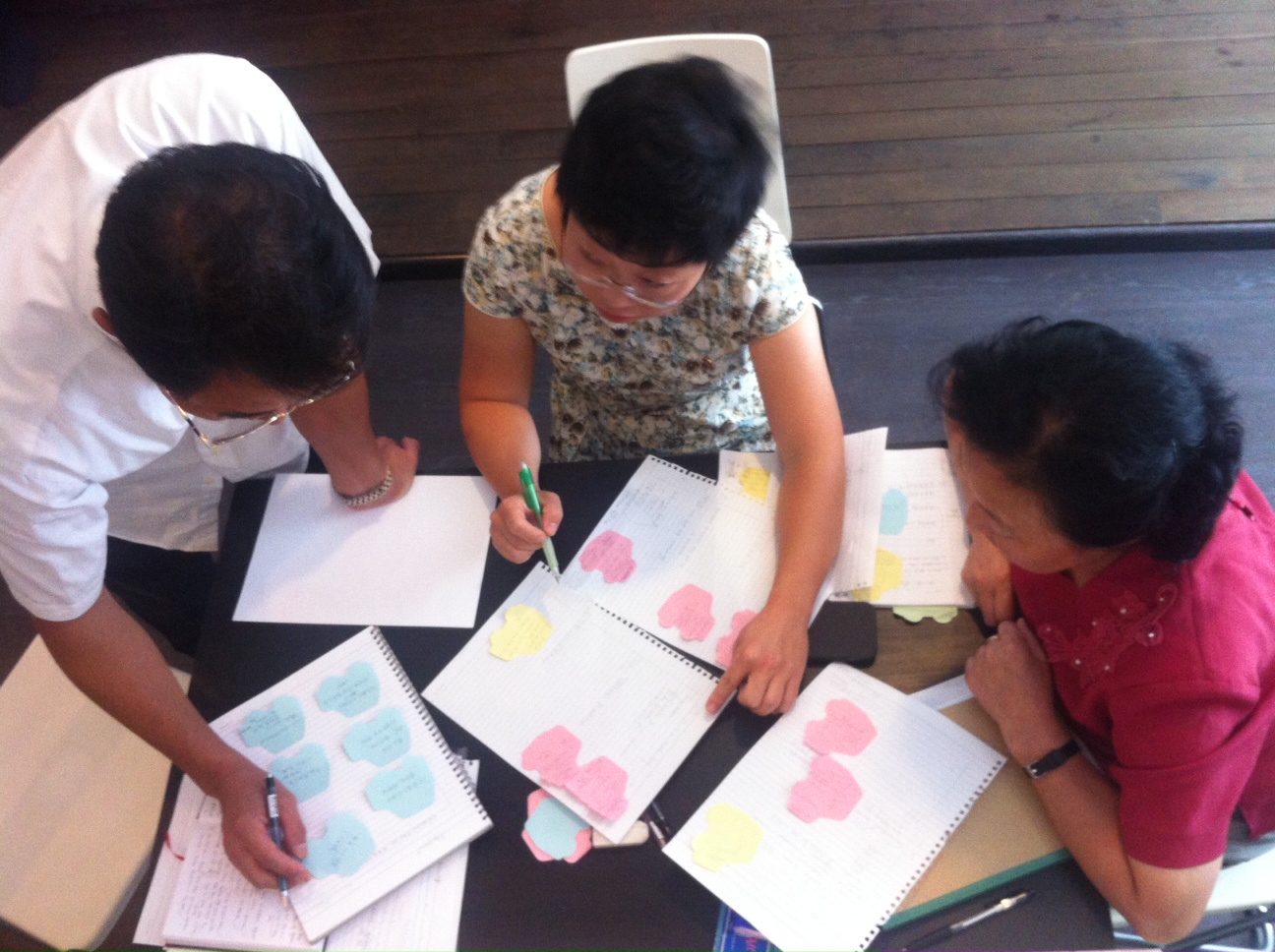
Workshop participants preparing for a presentation to invited guests

Workshop participants preparing for a presentation to invited guests

“Will there be special visa policies for Wonsan? … Is it possible to bring foreign workers in to work? … Can the lease of land be renewed after 50 years? …”

In October, Choson Exchange organized its first ever-training program for North Koreans in Vietnam. Participants spent a week in Vietnam learning about the land lease/sales issues and came to Singapore for another week to further study the issues in a different context.

The workshops concluded with vibrant discussions between our North Korean participants and invited guests, which included industry experts and seasoned investors. For over three hours, they exchanged opinions on the development of the Kangwon province on the East Coast, which includes Wonsan city, and sits on the border with South Korea and faces Japan. For those unfamiliar with this less-visited part of North Korea, this area also includes Masik Pass Ski Resort, the recently renovated Songdowon Children’s Camp, and the Kalma Beach Resort. 

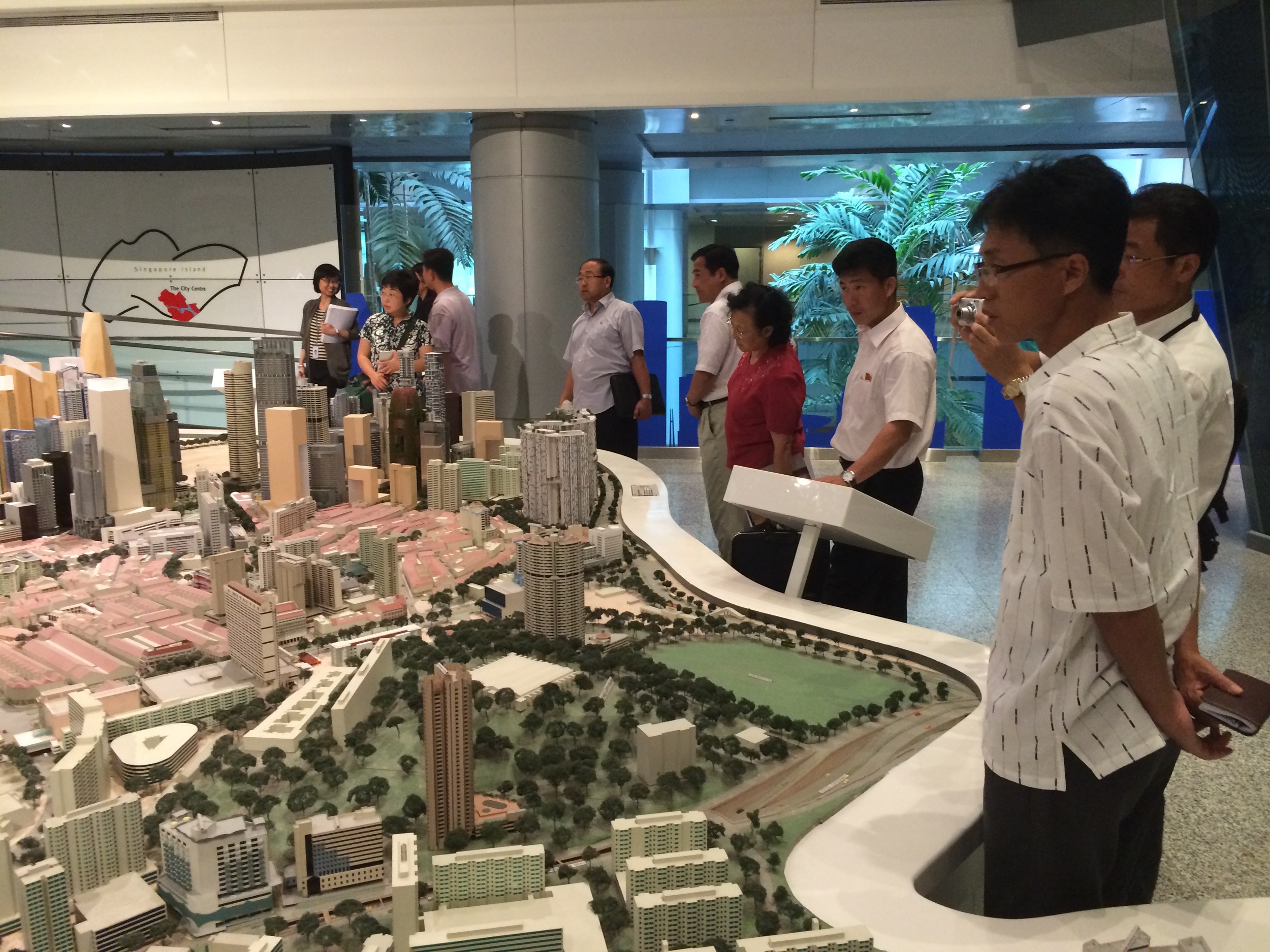
Participants visit a masterplanning institute in Hanoi

Participants visit a masterplanning institute in Hanoi

With much media coverage on the feasibility of Wonsan’s ambitious plan to become a key tourist destination, we were fortunate to have a group of researchers and managers working on the region’s development, which gave us a more clarity on the status and outlook of the project. 

Calvin, the urban planner and architect who put together part of the program, had the following comments:

Think Big

For a start, the macro strategy seems to make sense. I think there are several broad strategic moves that are generally positive. From a planning perspective, the incorporation of Wonsan, Tongchon and Mount Kumgang into a single development area is a natural choice in terms of their complementary urban, geographical and natural landscape profiles. In fact, this regions development potential has already been identified by Hyundai Asan in 2007 and Kempinski Group in 2011.

Learning about land issues at the Urban Redevelopment Authorities gallery

Learning about land issues at the Urban Redevelopment Authorities gallery

In addition, the administration has been streamlined with the creation of the General Development Corporation for Wonsan Region under the purview of Ministry of External Economic Affairs, with the ability to bring in relevant local organisations and ministries to work on specific areas of the project. Such a move would provide clarity for investors in having to go to a single agency instead of negotiating the complicated web of local organisations. Also, it may deter unnecessary duplication of competing infrastructural and administrative functions in different cities within the zone. [Editor: It remains to be seen how stable this entity will be, as many investment agencies get folded into other organizations after failing to make progress]

Focus Small

Given the sheer size of the 430km2 zone, defining the right project to begin with can be challenging. In fact, one of the common discussions throughout the workshop was identifying the priorities for development where participants each echoed their rationale, with some prioritising the construction of new hotels to attract tourists and others prioritising the improvement of road infrastructure to allow better accessibility to the region. 

However, one workshop leader emphasized caution in equating the delivery of infrastructure to progress for the tourism zone. He mentioned that while it is easier to measure and track the development of physical infrastructure, it is more important and also more difficult in creating the right experience and environment to attract tourists. In addition, the success of expensive long-term infrastructure projects is highly susceptible to economic and political tides. PLT´s $200 million Korean-drum inspired airport terminal in Wonsan is a case in point. However, according to some of the participants, construction of an airport is currently underway with a simpler clam-shaped terminal.

In addition, some of the workshop leaders also emphasized the need for more creative ways in funding and implementing the projects. One of them explained that developing the tourism zone is not only about creating a unique product for visitors, but also in coming up with a unique strategy to deliver that product. 

However, participants often focus on solving technical problems in the most direct way without considering alternative indirect solutions. Take passenger rail infrastructure as an example. Attracting foreign funds to develop the capital-intensive project is a topic of interest. Two workshop leaders addressed this issue, but instead of talking about tax incentives, as participants expected, participants heard about an entirely different funding model. The first workshop leader suggested that apart from seeking funding through direct sources, the cost of transport infrastructure could be financed through the sale of adjacent real estate, while the second questioned the relevancy of developing expensive passenger rail infrastructure all together. He explained that at the current stage of development with low passenger demand, it will be wiser to use bus systems before scaling up to more sophisticated rail systems when demand picks up. It was helpful that the workshop leaders explain the concepts based on their own personal experiences in developing projects as a developer and planner respectively, which helped the participants better understand their rationale behind the suggestions. 

Therefore, for this land development workshop, we took a different approach focusing on business fundamentals. Instead of focusing on policy topics, we decided to expose participants to specific topics of real estate development, tourism development, land planning, financing mechanisms, taxation, regulations, etc. We hope that by letting them experience the ground and interact with respective industry experts in Vietnam and Singapore, they would observe and pick up specific best practices and stimulate discussions on concepts that may be foreign to them.

In short, although there are still many details that need to be ironed out, various workshop leaders agreed that the broad strategies are generally pointing in the right direction. The Wonsan tourism zone may not the next Ha Long Bay or Sentosa in the near future. But if they can secure a few early wins, such as proposed by one of the participants, through developing favourable visa policies and twinning tour packages with other tourist destinations in Asia coupled with the completion of the airport, we may see more flights heading towards Wonsan in the near future.